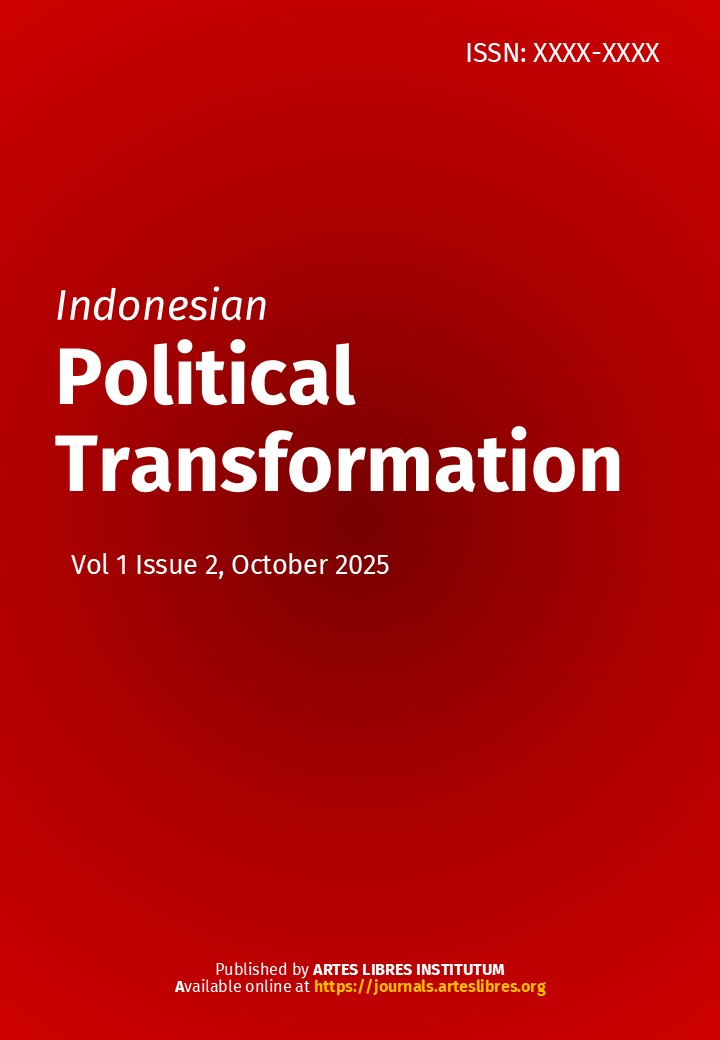
Digital Authoritarianism or Democratic Innovation? State Regulation of Social Media Platforms in Indonesia
DOI:
https://doi.org/10.67912/ipt.v1i2.45Keywords:
Digital Governance, Social Media Regulation, Democratic Innovation, Digital Rights, IndonesiaAbstract
Governments worldwide increasingly regulate digital platforms to combat misinformation, hate speech, and harmful online content. However, expanding regulatory authority also raises concerns regarding freedom of expression, democratic accountability, and state surveillance. Indonesia provides an important case for examining these competing dynamics because of its rapidly growing digital population and evolving regulatory framework governing social media platforms. This study explores whether Indonesia's digital governance reforms represent democratic innovation or a gradual movement toward digital authoritarianism. Using qualitative institutional analysis, the research examines legislation, judicial decisions, platform governance policies, and interviews with policymakers, civil society organizations, journalists, and technology experts. The findings indicate that Indonesia's regulatory approach reflects a hybrid governance model characterized by legitimate efforts to improve digital accountability alongside increasing concerns regarding discretionary enforcement, transparency, and protection of civil liberties. Rather than representing a binary choice between democracy and authoritarianism, Indonesia illustrates the complexities of governing digital spaces within emerging democracies facing competing demands for security, political stability, and digital rights. The article develops a conceptual framework explaining how regulatory legitimacy depends upon procedural transparency, institutional independence, proportional enforcement, and multi-stakeholder participation. The study contributes to comparative research on digital governance by providing evidence from the Global South, where institutional conditions differ significantly from Western democracies. The findings offer policy recommendations for designing balanced regulatory systems capable of addressing digital harms while preserving democratic freedoms and constitutional protections.
References
Bradshaw, Samantha, and Philip N. Howard. 2019. The Global Disinformation Order: 2019 Global Inventory of Organised Social Media Manipulation. Oxford: Oxford Internet Institute.
Bua, Adrià, and Oliver Escobar. 2018. "Participatory-Deliberative Processes and Public Policy Agendas." Policy Sciences 51 (3): 321–47.
DataReportal. 2024. Digital 2024: Indonesia. Singapore: Kepios.
Deibert, Ronald J. 2020. Reset: Reclaiming the Internet for Civil Society. Toronto: House of Anansi Press.
Flew, Terry. 2021. Regulating Platforms. Cambridge: Polity Press.
Freedom House. 2023. Freedom on the Net 2023: The Repressive Power of Artificial Intelligence. Washington, DC: Freedom House.
Gillespie, Tarleton. 2018. Custodians of the Internet: Platforms, Content Moderation, and the Hidden Decisions That Shape Social Media. New Haven, CT: Yale University Press.
Gorwa, Robert. 2019. "What Is Platform Governance?" Information, Communication & Society 22 (6): 854–71.
Kementerian Komunikasi dan Informatika Republik Indonesia. 2020. Peraturan Menteri Komunikasi dan Informatika Republik Indonesia Nomor 5 Tahun 2020 tentang Penyelenggara Sistem Elektronik Lingkup Privat. Jakarta: Kementerian Komunikasi dan Informatika.
Polyakova, Alina, and Chris Meserole. 2019. "Exporting Digital Authoritarianism: The Russian and Chinese Models." Brookings Institution.
Republik Indonesia. 2008. Undang-Undang Nomor 11 Tahun 2008 tentang Informasi dan Transaksi Elektronik. Jakarta: Sekretariat Negara.
Republik Indonesia. 2016. Undang-Undang Nomor 19 Tahun 2016 tentang Perubahan atas Undang-Undang Nomor 11 Tahun 2008 tentang Informasi dan Transaksi Elektronik. Jakarta: Sekretariat Negara.
Republik Indonesia. 2019. Peraturan Pemerintah Nomor 71 Tahun 2019 tentang Penyelenggaraan Sistem dan Transaksi Elektronik. Jakarta: Sekretariat Negara.
Republik Indonesia. 2024. Undang-Undang Nomor 1 Tahun 2024 tentang Perubahan Kedua atas Undang-Undang Nomor 11 Tahun 2008 tentang Informasi dan Transaksi Elektronik. Jakarta: Sekretariat Negara.
Safenet. 2023. Annual Report on Digital Rights Situation in Indonesia 2023. Denpasar: Southeast Asia Freedom of Expression Network.
SAFEnet. 2023. Laporan Situasi Hak-Hak Digital Indonesia 2023. Denpasar: Southeast Asia Freedom of Expression Network.
Smith, Graham. 2009. Democratic Innovations: Designing Institutions for Citizen Participation. Cambridge: Cambridge University Press.
United Nations Human Rights Committee. 2011. General Comment No. 34: Article 19: Freedoms of Opinion and Expression. Geneva: United Nations.
United Nations. 1948. Universal Declaration of Human Rights. New York: United Nations.
Downloads
Published
How to Cite
Issue
Section
License
Copyright (c) 2025 Salma Nabila Prameswari

This work is licensed under a Creative Commons Attribution 4.0 International License.
Authors retain full copyright ownership of their works without restriction. The views and opinions expressed in articles published in this journal are solely those of the respective authors and do not necessarily reflect the views of the journal, its editors, publishers, or the authors’ affiliated institutions. All content published in this journal is licensed under the Creative Commons Attribution 4.0 International License (CC BY 4.0).